My Impact At

Ever

Bright

User-Facing Data Quality Error Messages
Transparent monitoring with proactive error messaging
THE PROBLEM
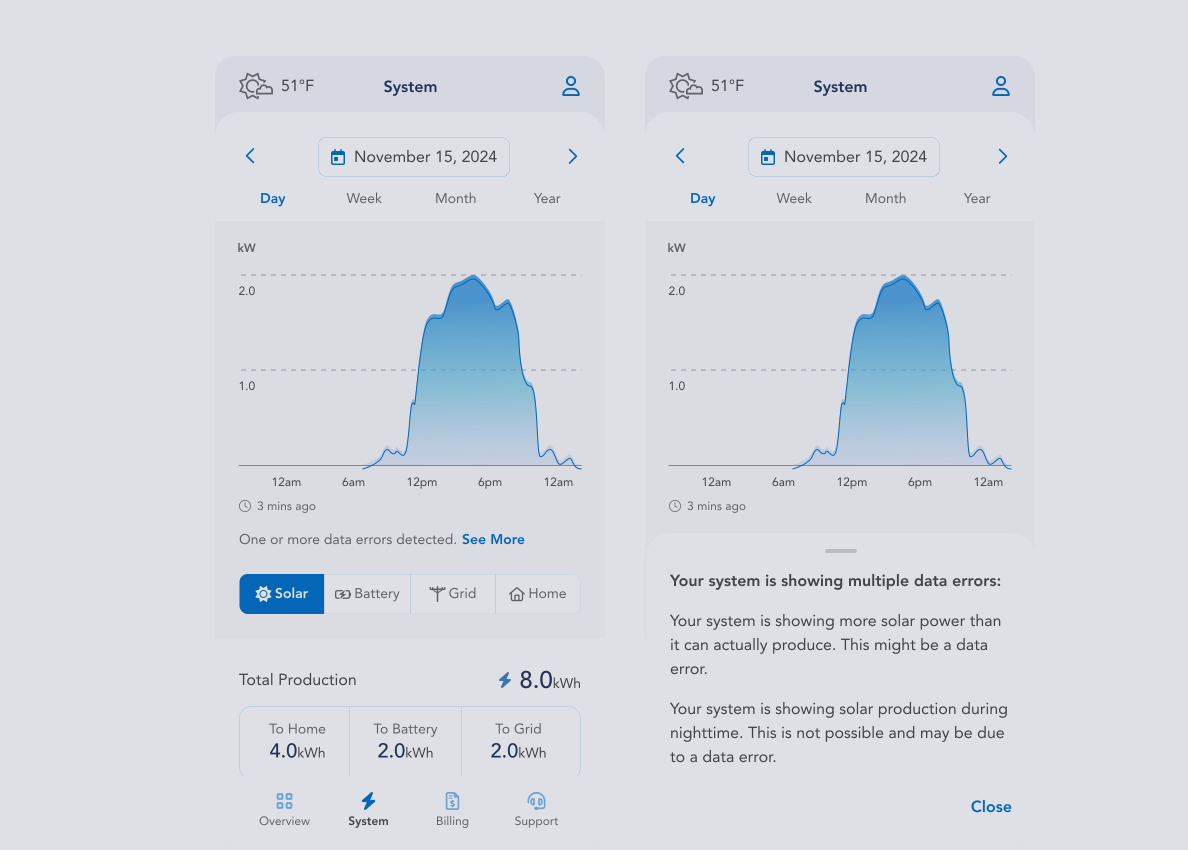
Energy monitoring graphs were ready to ship, but underlying OEM API data had quality issues (missing data, negative values, solar production at night). Releasing graphs with visible anomalies would erode homeowner confidence and overwhelm support, but delaying meant losing users to OEM apps.
PRODUCT GOAL
The highly-requested energy monitoring graphs (home consumption, grid import/export, battery charge/discharge) were feature-complete but faced a critical go/no-go decision due to data quality issues from OEM APIs.
IMPACT
Unblocked highly-requested monitoring feature release
Support tickets significantly lower than projected
Preserved homeowner confidence in system performance
Maintained customer touchpoint vs. losing to OEM apps
70%
SUPPORT DEFLECTION
+45%
USER ENGAGEMENT
0 Delay
TIME TO LAUNCH
PROBLEM & IMPACT
The Core Problem
Only 10% of Enphase PV+Battery sites had logical data 100% of the time; for SolarEdge, just 9%. Issues included solar production reported at night (CT clamps installed backwards), negative consumption values, and API latency causing data gaps.
User Pain Points
Misattribution: Users assumed data anomalies = broken solar system (not data issues)
Transparency Gap: Silent failures felt like being ignored on their biggest home investment
App Fragmentation: Juggling multiple apps (OEM + EverBright) for complete system visibility
BUSINESS IMPACT
Releasing with visible anomalies → Erode trust in $25,000+ solar investments
Damage EverBright's credibility as the financing partner
Support ticket overflow for issues we couldn't immediately fix
Opportunity Cost: Every day without graphs → Users defaulting to OEM apps
KEY DESIGN DECISIONS
Transform Data Quality from Blocker to Feature
TRADEOFF
Discovered another team had built data quality detection endpoints. Recognized we could repurpose this infrastructure for user-facing value.
RATIONALE
Partnered with data team to expose their quality detection logic through Real-Time Power Flow API. Created contextual, user-friendly error messages for each anomaly type.
Message Hierarchy: User Confidence Over Technical Accuracy
TRADEOFF
Sample error mapping: Solar at night → "We noticed unusual readings that may indicate a sensor configuration issue. Your system is operating normally—our team is reviewing the data."
RATIONALE
Missing data → "Some data is temporarily unavailable from [Enphase/SolarEdge]. This doesn't affect your system—we're working to restore it."
Ship with Acknowledged Imperfections
TRADEOFF
The Strategic Call: Shipping with acknowledged imperfections > waiting for perfect data. Bet that clear messaging would reduce tickets despite imperfect data.
RATIONALE
User Trust vs. Feature Velocity: Chose proactive transparency to maintain trust while shipping faster. Support Load vs. Feature Adoption: Clear messaging reduced tickets.
Cross-Functional Alignment
TRADEOFF
Engineering: Negotiated API changes to add data_quality object without breaking existing integrations. Support: Pre-emptively created documentation for common data anomalies.
RATIONALE
Installer Partners: Communicated that data issues ≠ installation problems
In-App Feedback Form
Transforming customer sentiment in a trust-challenged industry
THE PROBLEM
EverBright had no direct feedback channel for homeowners within the product—complaints went to app stores with unidentifiable userids, BBB, or were conflated with billing issues. Google Play at 2.21★ and App Store at 3.5★ were eroding confidence. NPS data was comingled, mixing platform issues with external service complaints.
PRODUCT GOAL
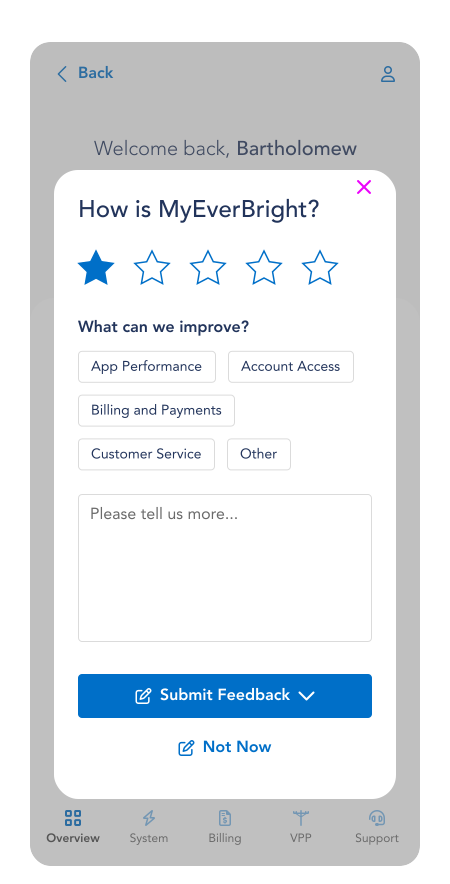
Create a lightweight feedback mechanism within the mobile and web apps that would give EverBright actionable insights into homeowner sentiment while improving perceived responsiveness.
IMPACT
Google Play rating improved from 2.21 to 4.27 (+92%)
App Store rating improved from 3.5 to 4.6 (+31%)
Support costs reduced by 25%
Support tickets/outreach reduced by 17%
+92%
GOOGLE PLAY
+31%
GOOGLE PLAY
-25%
SUPPORT COSTS
PROBLEM & IMPACT
The Core Problem
EverBright had zero direct touchpoint with homeowners managing 25-year PPA agreements through our apps. This gap manifested in contaminated data, expensive misdirection, and strategic blindness.
User Pain Points
Homeowners' frustration stemmed from feeling unheard post-installation, not just technical issuesScale operators: Processing 30-50+ transactions daily, stuck making compliance vs. speed tradeoffs
Platform performance (our responsibility) conflated with billing/purchasing issues (external services)
System production concerns (shared responsibility) with no clear feedback path
Feeling unheard after post-installation handoff in 25-year contracts
BUSINESS IMPACT
Contaminated data: App Store ratings conflated with billing/purchasing complaints we didn't control
Strategic blindness: No visibility into production issues affecting $XXX M securitized solar portfolio
Expensive misdirection: Support tickets bouncing between teams, costing $XXX/ticket
Industry context: 1,000%+ growth in consumer complaints far outpacing installation growth
KEY DESIGN DECISIONS
Simple 5-star + category vs. Complex Taxonomy
TRADEOFF
Less data granularity but 68% completion rate (vs. industry 15-20%). Faster to ship and iterate with basic categories.
RATIONALE
Wanted real data to inform refinement rather than guessing. Later refined based on actual submissions to reduce "Other" bucket usage.
Required Login Authentication
TRADEOFF
Lower volume but clean data: 100% attributable to actual customers. Enabled better triage and personalized follow-up.
RATIONALE
40% of users never need splits—don't disrupt their workflow
Selective Follow-up Based on Severity
TRADEOFF
Reduced support burden by 35%. Automated routing reduced manual triage time significantly.
RATIONALE
Some users feel ignored, but volume eventually justified automation. Volume management was necessary for sustainability.
Intelligent Routing with Context Capture
TRADEOFF
Captured context: Device info, account state, user journey automatically attached. Routed intelligently to correct teams.
RATIONALE
Categorization directed issues to correct teams, avoiding $200/ticket misdirection. Closed the loop with review prompts.
Unlocking $X.XM in VPP Revenue
Real-time reconciliation
THE PROBLEM
Despite having thousands of battery-equipped solar customers eligible for lucrative Virtual Power Plant (VPP) grid service programs, EverBright was leaving ~$500K annually on the table. The root cause: 70% of eligible sites lacked the Customer Identification Numbers (SAIDs) required for VPP enrollment.
PRODUCT GOAL
Collect Customer Identification Numbers (SAIDs) from 1,000+ battery-equipped customers to enable zero-baseline compensation in distributed energy programs, removing primary bottleneck to VPP enrollment.
IMPACT
Reduced cash handling liability
+92%
GOOGLE PLAY
+92%
GOOGLE PLAY
+92%
GOOGLE PLAY
PROBLEM & IMPACT
The Core Problem
Low email engagement rates - Industry-standard open rates for transactional emails hover around 20-30%, but critical communications about payments, system activation, and service requirements were going unread.
User Pain Points
Regulatory compliance risks - Critical documents like Authoritative Copy acknowledgments requiring customer action were delayed
Calling support for information they had received but missed via email
System activation delays from missed critical communications
Customers missing payment deadlines due to lack of timely reminders
BUSINESS IMPACT
Increased support volume - Customers calling for information already sent via email
Regulatory compliance risks - Delayed acknowledgments on critical documents
Payment delinquencies - Homeowners missing payment deadlines
Customer acquisition cost impact: $3,000-$5,373 per customer - losing customers to poor communication was unsustainable
KEY DESIGN DECISIONS
Sophisticated Notification Hierarchy vs. Email Replication
TRADEOFF
Rather than simply replicating emails as push notifications, designed 7-tier priority system: Early Access, Billing (payment critical), VPP Events, Account Management, System Alerts, Marketing/Upselling, Kudos/Congratulations.
TRADEOFF
Push-only for real-time critical alerts (grid outages, storm warnings). Push + Email for high-importance actions (ACH enrollment, payment reminders). Intelligent routing based on user preferences and device capabilities.
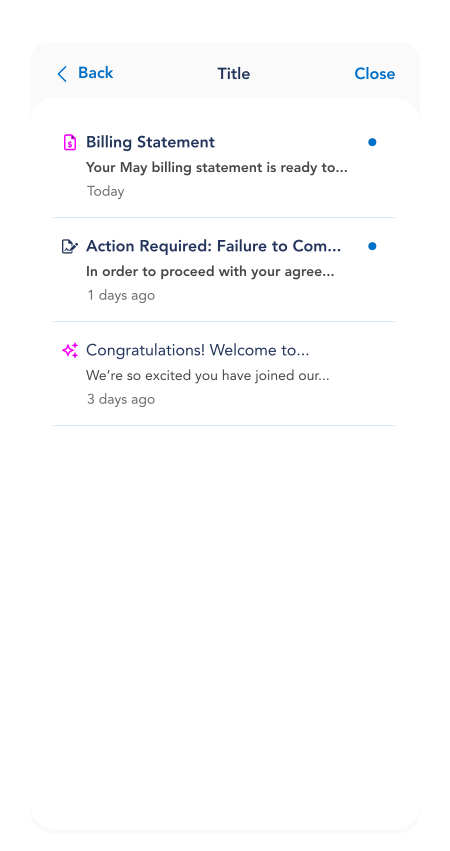
In-App Message Center for 100% Visibility
TRADEOFF
Critical Insight: With iOS opt-in rates at ~40%, needed to ensure message visibility regardless of notification permissions.
TRADEOFF
Additional development complexity but guaranteed delivery. Created persistent record of all communications accessible anytime.
Advanced Segmentation Strategy
TRADEOFF
Implemented segmentation across System Configuration (solar-only vs. solar+storage), Geographic (state-specific regulations and VPP eligibility), Behavioral (ACH enrollment status, payment history), Lifecycle (days since PTO, approaching buydown eligibility).
TRADEOFF
Complex backend logic but dramatically improved message relevance and reduced notification fatigue.
Deep Linking Architecture
TRADEOFF
Multi-language support planning for Spanish-speaking customers (significant in key markets like California). Time zone intelligence ensuring notifications arrive between 8 AM - 8 PM local time. Granular notification controls respecting user preferences.Implemented comprehensive deep linking to reduce friction from notification to action, supporting routes for: Direct payment processing, Welcome checklist completion, Auth copy acknowledgment, System monitoring dashboards.
TRADEOFF
Engineering investment upfront but eliminated multi-step navigation, driving 3x faster task completion.
User-Centric Safeguards
TRADEOFF
Multi-language support planning for Spanish-speaking customers (significant in key markets like California). Time zone intelligence ensuring notifications arrive between 8 AM - 8 PM local time. Granular notification controls respecting user preferences.
TRADEOFF
Smart frequency capping: Maximum 3 notifications/week with cooldown periods. Fallback mechanisms: Email backup for failed push deliveries. A/B testing framework for message optimization.
Push Notifications & Message Center
Transforming customer engagement infrastructure
THE PROBLEM
Low email engagement rates (20-30% open rates) meant critical communications about payments, system activation, and service requirements went unread. This led to increased support volume, payment delinquencies, and regulatory compliance risks. With customer acquisition costs of $3,000-$5,373 per customer, losing customers to poor communication was unsustainable.
PRODUCT GOAL
Revolutionize customer communication infrastructure to address critical gap impacting business metrics. Enable timely, relevant communications that drive user action while respecting user preferences and preventing notification fatigue.

IMPACT
30% improvement in notification engagement vs. email-only
50% reduction in support tickets for missing communications
3x faster completion of critical onboarding steps
Foundation for VPP enrollment and payment optimization
+30%
ENGAGEMENT LIFT
50%
SUPPORT REDUCTION
3x
ONBOARDING SPEED
PROBLEM & IMPACT
The Core Problem
Low email engagement rates - Industry-standard open rates for transactional emails hover around 20-30%, but critical communications about payments, system activation, and service requirements were going unread.
User Pain Points
Customers missing payment deadlines due to lack of timely reminders
System activation delays from missed critical communications
Calling support for information they had received but missed via email
Regulatory compliance risks - Critical documents like Authoritative Copy acknowledgments requiring customer action were delayed
BUSINESS IMPACT
Increased support volume - Customers calling for information already sent via email
Regulatory compliance risks - Delayed acknowledgments on critical documents
Payment delinquencies - Homeowners missing payment deadlines
Customer acquisition cost impact: $3,000-$5,373 per customer - losing customers to poor communication was unsustainable
KEY DESIGN DECISIONS
Sophisticated Notification Hierarchy vs. Email Replication
TRADEOFF
Rather than simply replicating emails as push notifications, designed 7-tier priority system: Early Access, Billing (payment critical), VPP Events, Account Management, System Alerts, Marketing/Upselling, Kudos/Congratulations.
TRADEOFF
Push-only for real-time critical alerts (grid outages, storm warnings). Push + Email for high-importance actions (ACH enrollment, payment reminders). Intelligent routing based on user preferences and device capabilities.
In-App Message Center for 100% Visibility
TRADEOFF
Critical Insight: With iOS opt-in rates at ~40%, needed to ensure message visibility regardless of notification permissions.
TRADEOFF
Additional development complexity but guaranteed delivery. Created persistent record of all communications accessible anytime.
Advanced Segmentation Strategy
TRADEOFF
Implemented segmentation across System Configuration (solar-only vs. solar+storage), Geographic (state-specific regulations and VPP eligibility), Behavioral (ACH enrollment status, payment history), Lifecycle (days since PTO, approaching buydown eligibility).
TRADEOFF
Complex backend logic but dramatically improved message relevance and reduced notification fatigue.
Deep Linking Architecture
TRADEOFF
Multi-language support planning for Spanish-speaking customers (significant in key markets like California). Time zone intelligence ensuring notifications arrive between 8 AM - 8 PM local time. Granular notification controls respecting user preferences.Implemented comprehensive deep linking to reduce friction from notification to action, supporting routes for: Direct payment processing, Welcome checklist completion, Auth copy acknowledgment, System monitoring dashboards.
TRADEOFF
Engineering investment upfront but eliminated multi-step navigation, driving 3x faster task completion.
User-Centric Safeguards
TRADEOFF
Multi-language support planning for Spanish-speaking customers (significant in key markets like California). Time zone intelligence ensuring notifications arrive between 8 AM - 8 PM local time. Granular notification controls respecting user preferences.
TRADEOFF
Smart frequency capping: Maximum 3 notifications/week with cooldown periods. Fallback mechanisms: Email backup for failed push deliveries. A/B testing framework for message optimization.